
Written by: Elliot Funt, Real Estate Advisor, Engel & Völkers Vancouver
Why Small Condo Buildings Work So Well in North Vancouver
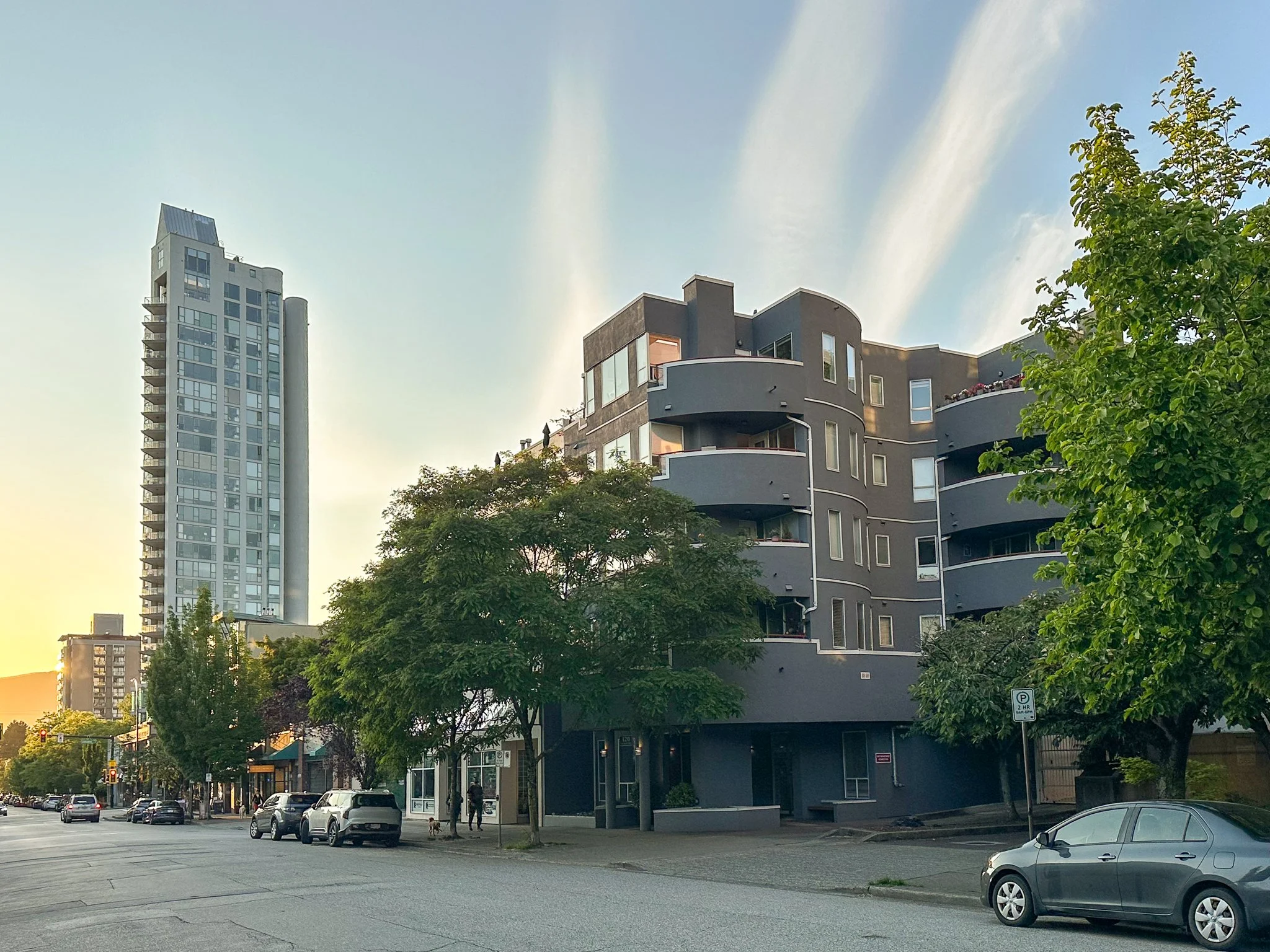
Most buyers in North Vancouver default to large condo towers because those are the buildings that get advertised the most. Tall buildings, glossy renderings, and long amenity lists are especially common around Lower Lonsdale and other higher-density pockets. What gets talked about far less is how pleasant daily life can be in a small residential building.
Having lived in, owned, and advised clients on both, I am fairly convinced that small buildings are one of the most underrated housing options in North Vancouver.
Here is why, and I will put my own cards on the table first.
A Quick Personal Context
I live in a very small 11-unit building in North Vancouver.
It is not flashy. There is no concierge. No rooftop pool. But I genuinely love it.
My unit, and several others in the building, has large skylights that completely change how the space feels. It stays bright, open, and livable year-round, even on grey North Shore days. I also have an unusually large, very convenient parking stall, which sounds minor until you have tried squeezing into underground parking designed like a bad game of Tetris.
That kind of day-to-day livability is exactly what small buildings tend to get right on the North Shore.
You Actually Know Who You Live With
In a small building, you recognize people. You know who owns, who rents, who has kids, and who works nights. That alone changes the tone of the place.
There is less anonymity, fewer conflicts, and generally more accountability. People tend to take better care of common spaces when they feel some ownership over them, not just financially, but socially.
It Is Noticeably Quieter, Which Matters on the North Shore
This is one of the first things people comment on after moving from a large tower.
Fewer units means fewer doors slamming, fewer elevators running all night, fewer short-term rentals, fewer moving trucks, and less general chaos. On the North Shore, where buildings are often closer together and sound carries differently through hillsides and denser neighbourhoods, this makes a real difference.
Hallways feel calmer. Common areas do not feel constantly used up. You are not sharing your building with hundreds of strangers.
Almost No False Fire Alarms
This deserves its own section.
Large condo towers are notorious for false fire alarms. One burnt piece of toast, one malfunctioning sensor, or one careless tenant can end with the entire building being evacuated at 2 a.m.
In parts of North Vancouver where density has increased quickly, this is a common frustration. Small buildings largely avoid it. Fewer units, simpler systems, and fewer people accidentally setting things off all help. It is a real quality-of-life improvement that does not show up on a listing sheet but matters a lot once you live there.
More Interesting Floor Plans, Especially in Older North Van Stock
Many of North Vancouver’s smaller condo buildings pre-date the cookie-cutter condo era, particularly in Central Lonsdale, Lower Lonsdale, and Lynn Valley.
As a result, units tend to have more character. Better proportions, fewer awkward angles, real separation between living spaces, and sometimes even windows on multiple sides.
They are not always flashy, but they are usually more livable.
Less Competition for the Basics, Especially Parking
Parking, storage, bike rooms, laundry, and guest parking all tend to be at a premium in North Vancouver.
In small buildings, you are not competing with 200 other people for the same limited resources. Things work the way they are supposed to, and when they do not, they get noticed quickly.
Lower Day-to-Day Operating Costs
Small buildings generally do not have concierges, pools, bowling alleys, or massive mechanical systems. That often translates into lower monthly strata fees and fewer line items you are paying for but never using.
In a wet North Shore climate, fewer systems also means fewer points of failure when it comes to roofs, drainage, and building envelopes. Simple buildings tend to stay simpler, and often more affordable, over time.
More Say in How the Building Is Run
In a small strata, your voice actually matters. Decisions are not made by a handful of people representing hundreds of owners who have never met each other.
Budgets, maintenance planning, and long-term decisions tend to be more practical and less political.
The Trade-Off: Special Levies
Yes, small buildings can face higher per-unit special levies when major work is required.
A roof replacement split between 11 units feels different than one split between 300. That is just math.
Where people get this wrong is assuming that special levies mean a building is poorly run. Often it is the opposite. The strata is actually dealing with issues instead of deferring them.
The real risk is not the levy itself. The real risk is buying into a building without understanding what is coming.
Another Real Issue: Incomplete or Outdated Building Records
This is another reality of small buildings that is worth being honest about.
Some smaller stratas do not have perfectly updated depreciation reports. Minutes can be thin. Maintenance histories are not always beautifully documented or professionally packaged.
That does not automatically mean the building is risky. In many cases, it just means the strata is informal, self-managed, or has not been forced by scale to professionalize everything.
Where buyers get into trouble is either assuming missing paperwork equals missing maintenance, or ignoring the gap altogether.
Where a Very Good Home Inspector Earns Their Fee
This is where a strong home inspector becomes especially valuable.
A good inspector will assess a small condo building much like they would a single-family house. Roof condition, drainage, structure, envelope details, mechanical systems, and visible signs of deferred maintenance all matter.
In many cases, they will spot real-world issues, or confirm the absence of them, far more effectively than relying solely on incomplete paperwork.
This Is Where a Good Advisor Matters
Before buying into any small building, you want someone who will actually read the depreciation report, even if it is older, the strata minutes properly, the contingency reserve fund, and the building’s observable maintenance condition.
A well-maintained small building with a clear, practical approach to upkeep is often far less risky than a large tower quietly deferring expensive problems.
Context matters more than paperwork volume.
Final Thoughts Through a North Vancouver Lens
Small condo buildings are not for everyone. If you want hotel-style amenities or total anonymity, they are probably not your thing.
But if you value quiet, stability, fewer surprises, and a building that actually feels livable, small buildings deserve serious consideration, especially in North Vancouver.
They rarely market well. They do not photograph as dramatically. They are often overlooked.
For the right buyer on the North Shore, that is exactly the point.
Reach out to me at Elliot@Funt.ca or (778) 991 - 3868 (text/phone).
Elliot Funt - Real Estate Advisor with Engel & Völkers Vancouver

