
Written by: Elliot Funt, Real Estate Advisor, Engel & Völkers Vancouver
Why I Often Lean Toward Older Concrete Condo Buildings in Downtown Vancouver
Spend enough time walking through downtown Vancouver condos and certain patterns start to stand out. Not just the obvious stuff like finishes or amenities, but how a building actually feels once you are inside it. Over the years, I’ve found myself leaning more and more toward older concrete towers that have already had time to show what they are.
This is not nostalgia, and it is not me saying newer buildings are bad. It is just where I have landed after seeing a lot of condos, talking to a lot of owners, and reading a lot of strata documents. The older I get, the less interested I am in whatever looks best in brochure photos, and the more interested I am in how a place actually lives.
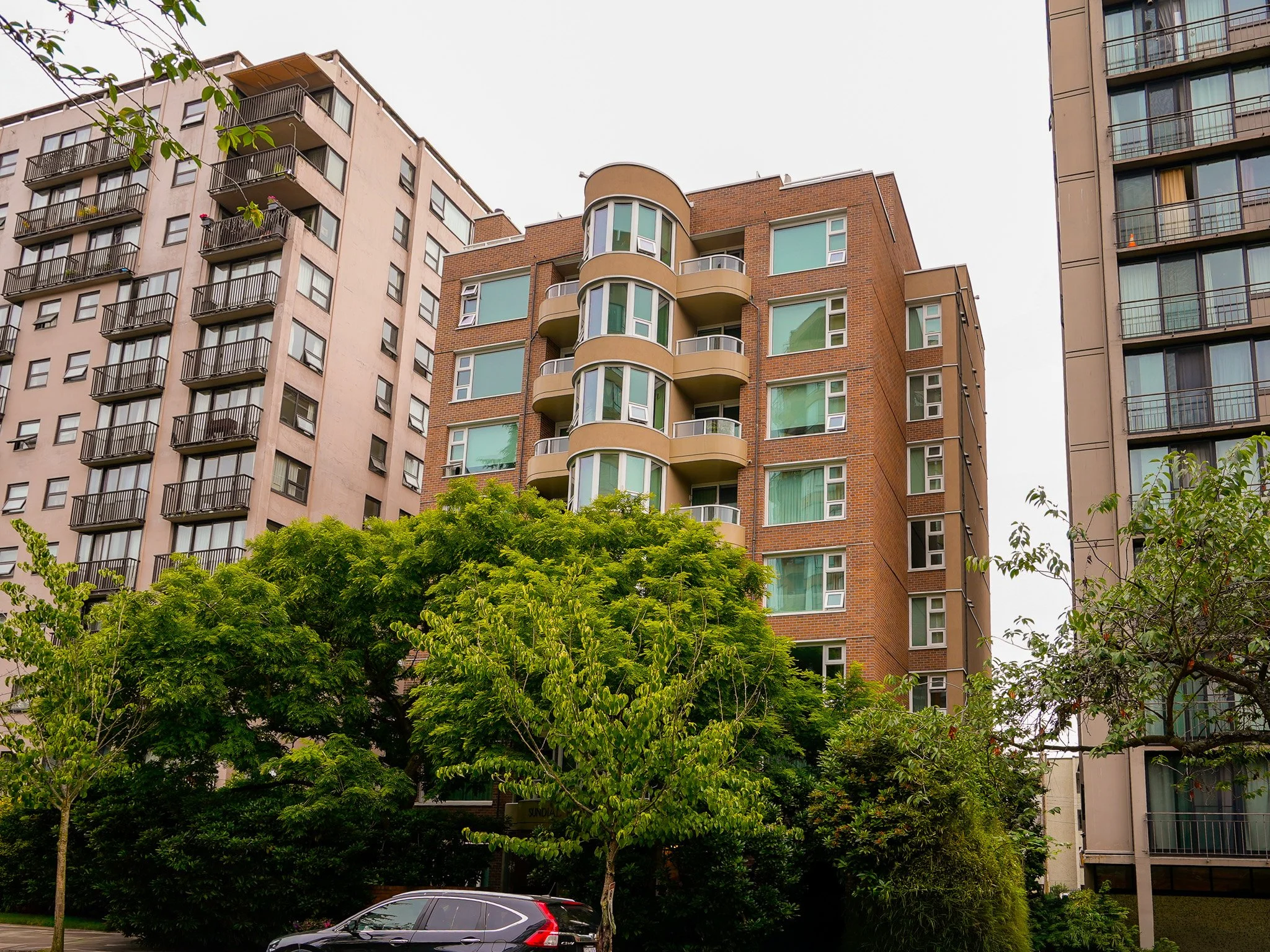
For this kind of conversation, I’m usually talking about concrete buildings from roughly the 1970s to early 2000s. The kind of buildings you see around the West End, Yaletown, Coal Harbour, Crosstown, and parts of Gastown and Railtown. They are not always the flashiest, and sometimes they do not photograph as well as newer towers, but that is kind of the point.
A lot of them just feel better.
You notice it pretty quickly when you have been walking newer product and then step into an older concrete building that has good bones. The floors feel solid. The space often feels quieter. The layout usually makes more sense. Bedrooms are often bigger. Dining areas actually fit a table. Living rooms feel like living rooms instead of leftover space beside a kitchen island.
That obviously is not true of every older building, and not every newer building gets it wrong. But I do think a lot of older concrete homes were designed with more attention to how people actually live, not just how a unit looks online or how many features can be crammed into the marketing.
Another thing I like is that you can usually get a much clearer read on the building itself. By that point, it has a history. You can go through minutes, depreciation reports, and past projects and get a pretty good sense of whether the place has been well run or not. That matters to me. I would rather look at a building that has already been tested a bit than one that is still in the early stage where nobody really knows how things are going to go.
That is part of why newer buildings do not always automatically feel safer to me, even though a lot of buyers assume they are. New is nice. New is clean. New is easy to get excited about. But the first few years of a building can be a bit of a honeymoon phase. Then the wear starts to show, warranty issues come up, common areas get banged around, and the strata is still figuring itself out. There is not much track record yet, and sometimes that lack of history is exactly what gives me pause.
With an older building, at least you usually know more about what you are dealing with. Maybe the piping has already been done. Maybe the elevators have been upgraded. Maybe the envelope work is behind it. Maybe the strata has shown over time that it is willing to make hard decisions before things get worse. I find that a lot more reassuring than a polished lobby and some slick staging.
Of course, older does not automatically mean better. Some older buildings are disasters. Deferred maintenance, repeated levies, poor electrical capacity, insurance headaches, a council that does not communicate well. That stuff matters. But I still often prefer looking at an older building with a visible track record, even if it has had issues, over a newer one where the real story has not shown up yet.
Micro-location matters too. Two similar buildings can feel completely different depending on the block, the exposure, the amount of traffic, the airflow, and how much natural light gets into the units. That part gets missed all the time when people talk too broadly about building quality. Sometimes the better buy is not the newer building or the nicer lobby. It is just the one that feels better to be in.
That is really what this comes down to for me. Livability. Predictability. A sense that the building has already shown its habits. Older concrete towers are not always the answer, but a lot of them hold up extremely well, and I think plenty of buyers overlook them because they are too focused on newness.
I get why newer buildings grab attention. But when it comes to the places I often feel best about recommending, it is very often the older concrete ones that keep rising to the top.
Contact me to get your search started today at Elliot@Funt.ca or (778) 991 - 3868 (text/phone).
Elliot Funt - Real Estate Advisor with Engel & Völkers Vancouver

